Key Findings
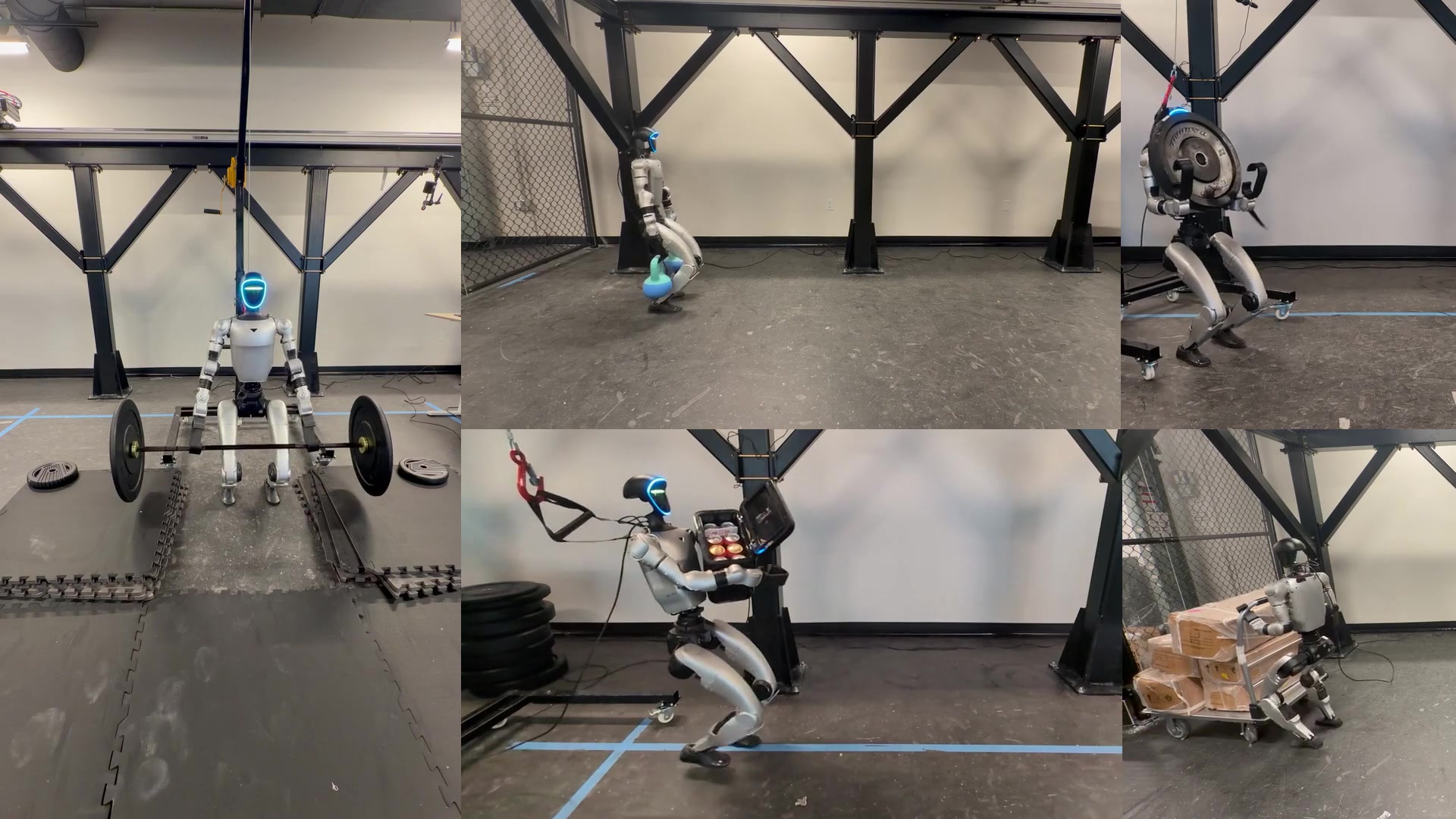
- MPC reward guidance lets the whole-body controller push and pull heavy objects, including a 300 kg cart.
- Capture-Point Constraints improve robustness to force disturbances and balance recovery, measured by DCM excursion.
Forceful cart pulling
The whole-body controller pulls a cart loaded to 300 kg on real hardware.
Better velocity performance
Lower tracking error while carrying 10 kg per arm in simulation.
Better balance recovery
DCM excursion after one-second torso pushes across the 50–100 N sweep in simulation.
Velocity and recovery metrics compare teachers trained with and without capture-point constraints across five simulation evaluation seeds. The 300 kg cart pull is a separate hardware demonstration. Protocol and full results ↗
MPC Reward Guidance
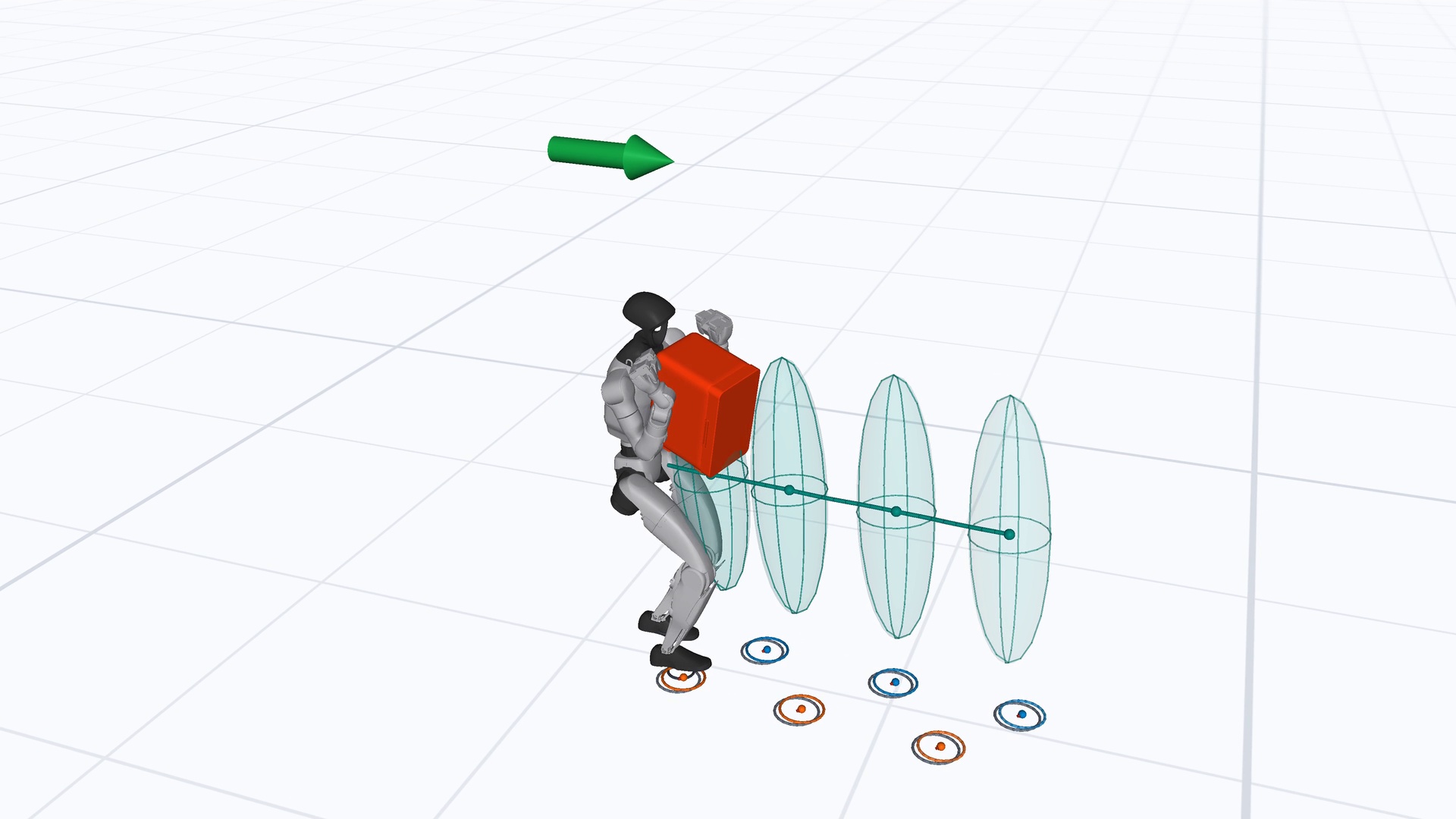
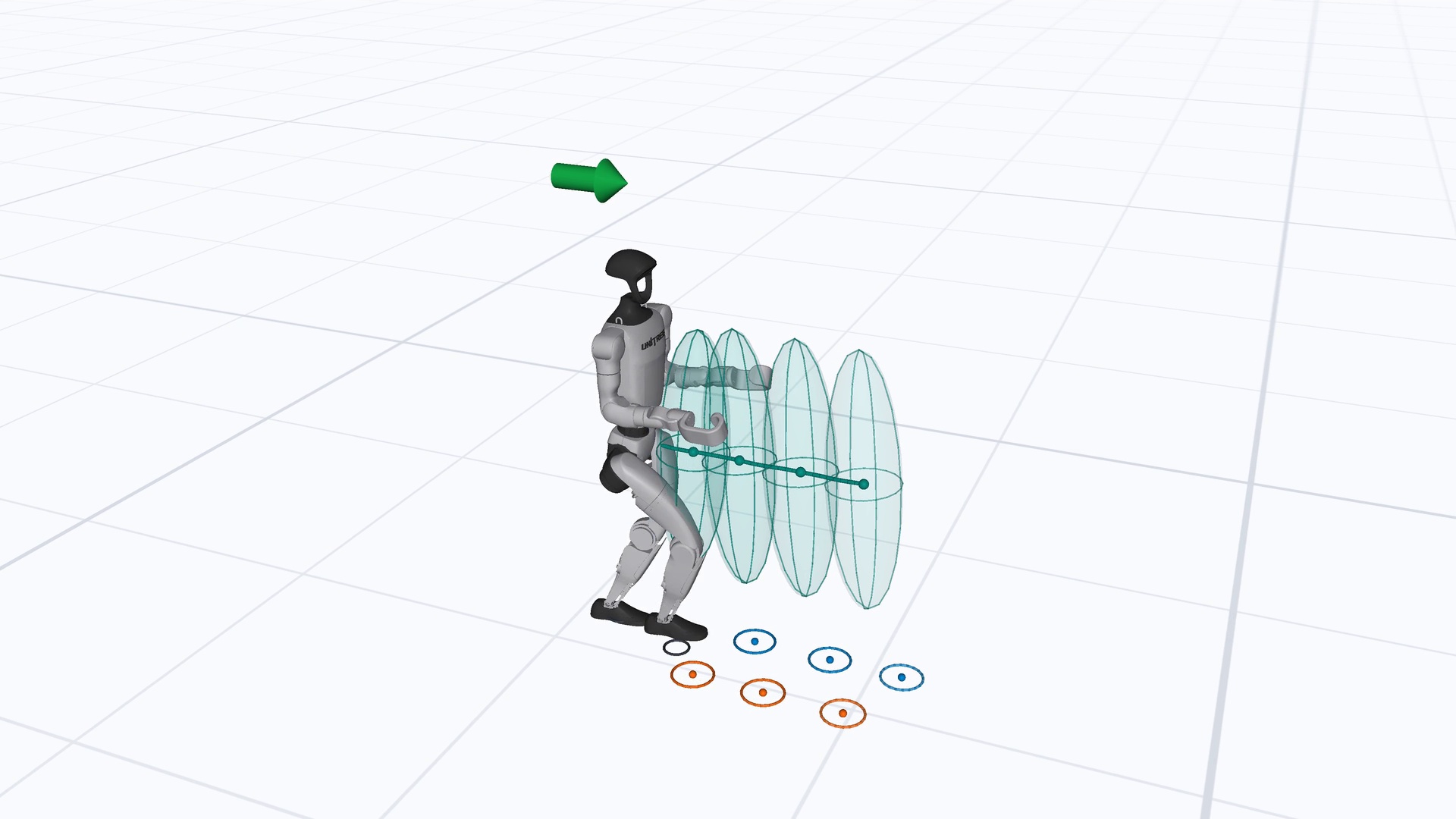
Two specialists learn with model predictive control (MPC) guidance. Their walking rollouts show planned footsteps and predicted body motion under changing loads.
Grasp MPC
Fridge carrying under a 0.5 m/s command as payload varies from 0.5 to 2 kg. Footstep targets and predicted body motion are shown at real-time playback speed.
Carry through changing loads.
Wrist-Force MPC
Walking under a 0.3 m/s command with a 40 N total backward load for five seconds, followed by release. Footstep targets and predicted body motion are shown at real-time playback speed.
Walk under an applied force.
Simulation demonstrations with different loads. The displayed 2.1-second preview extends the native 0.7-second MPC horizon.
MPC optimization for forces
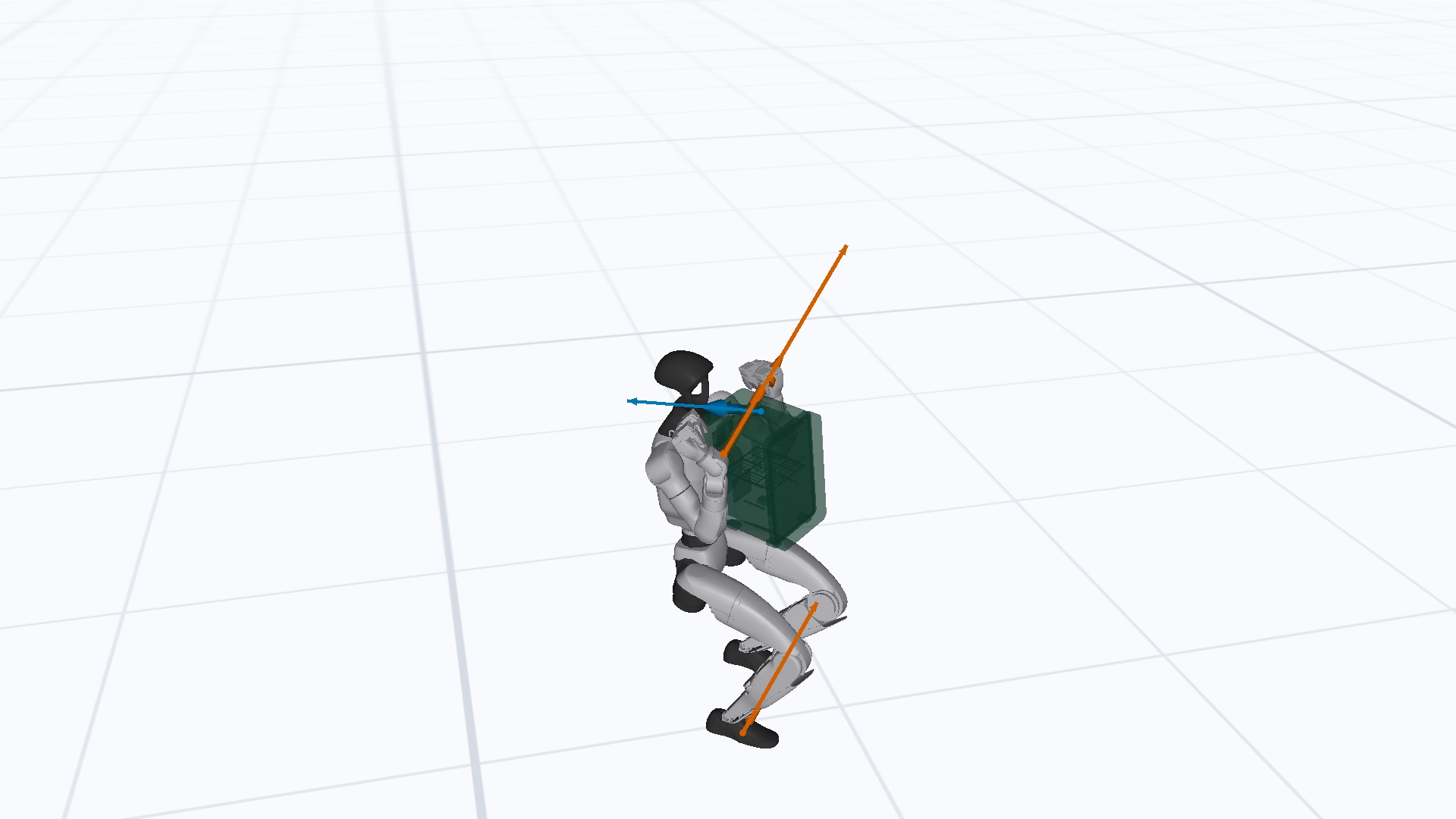
One frozen pose per clip; arrows show 128 solver iterations, not robot motion.
Joint grasp and ground forces
Torso/arm grasp forces and foot ground-reaction forces update together in one experimental solve.
Grasp and foot forces optimize together.
Locomotion forces
Foot and applied-load force decisions update through one locomotion solve.
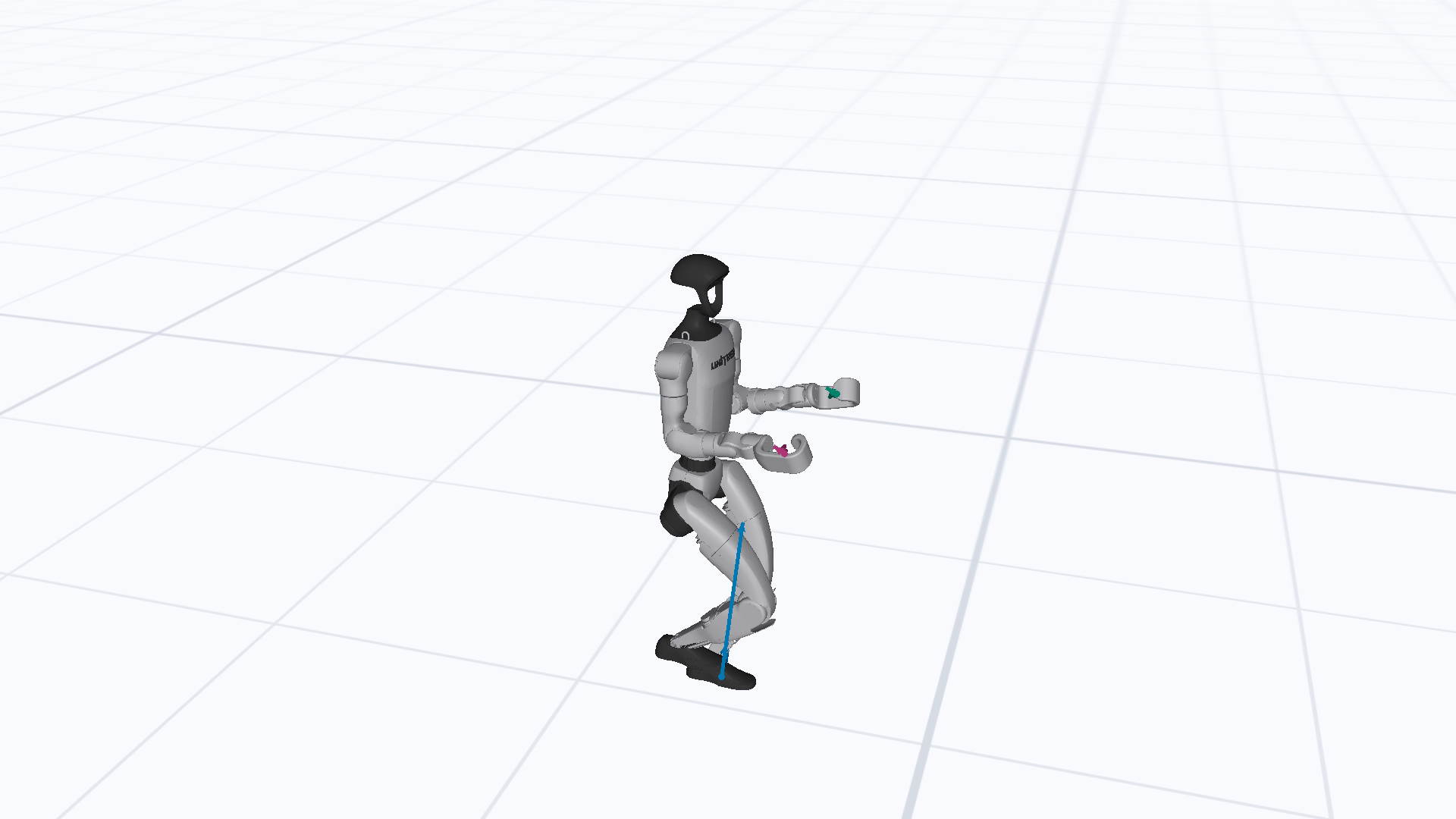
Force arrows change; the robot stays still.
CBF-RL
Capture-point barrier guidance teaches the force teacher to recover balance during training.
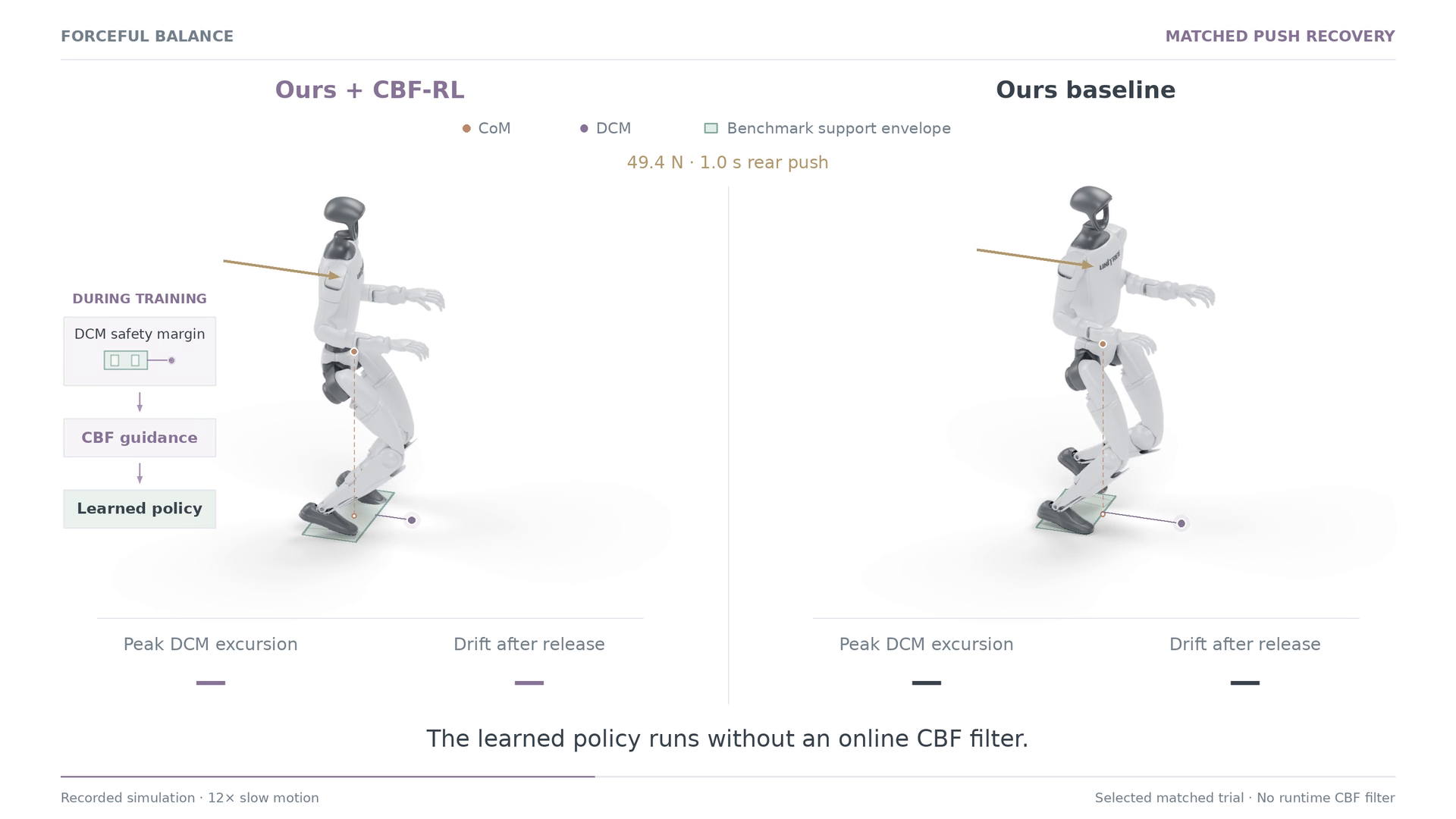
Capture point, support regions, recovery.
Two specialists. One controller.
A wrist-force teacher and a whole-body-grasp teacher distill their behaviors into one student with a shared command interface.
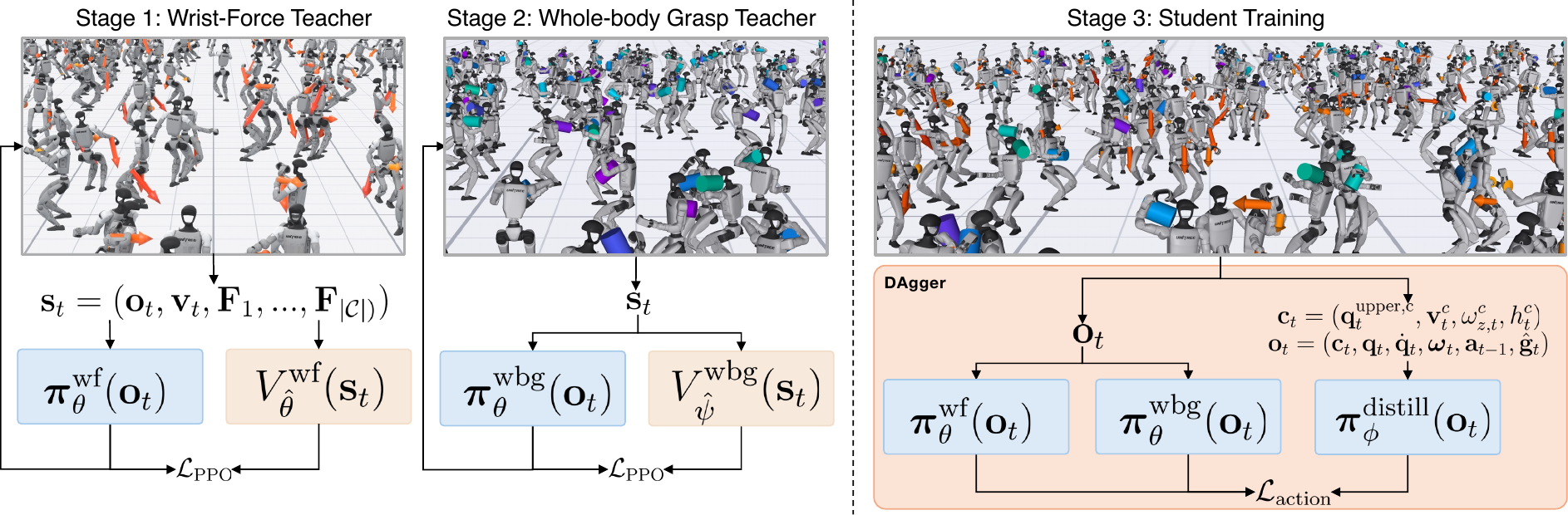
Teacher actors already use deployment observations; privileged state is supplied to their training critics. Simulation tables evaluate wrist-force teachers, while the hardware table evaluates the distilled student.
Planar velocity · Turning rate · Base height · Torso orientation · Arm joint targets
Training A · Force teacher
Teacher 1 learns to hold arm targets and follow motion commands under sustained wrist forces.
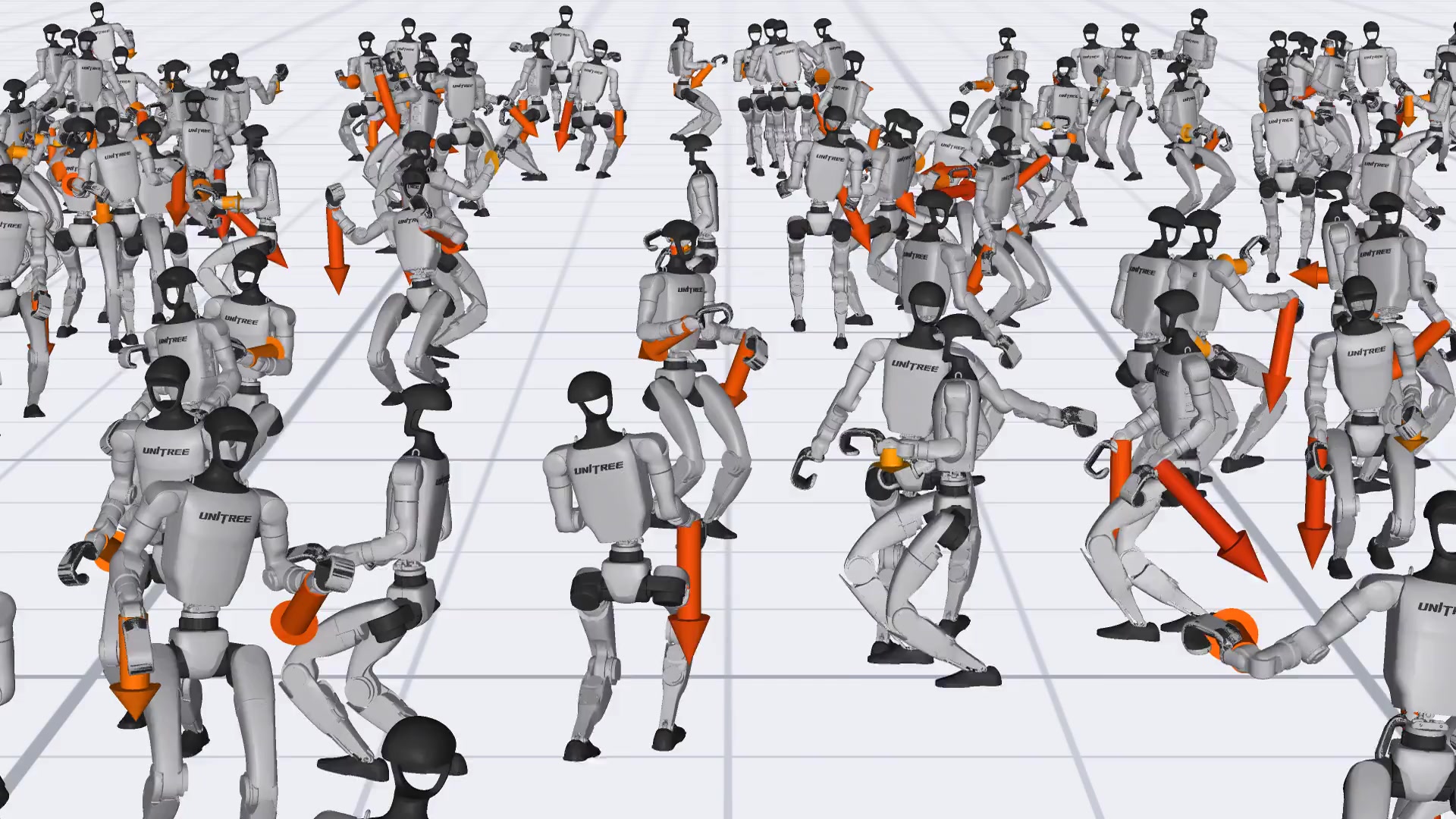
Sample a pose. Learn under force.
Training B · Grasp teacher
Teacher 2 learns to walk while carrying objects from established whole-body grasps.
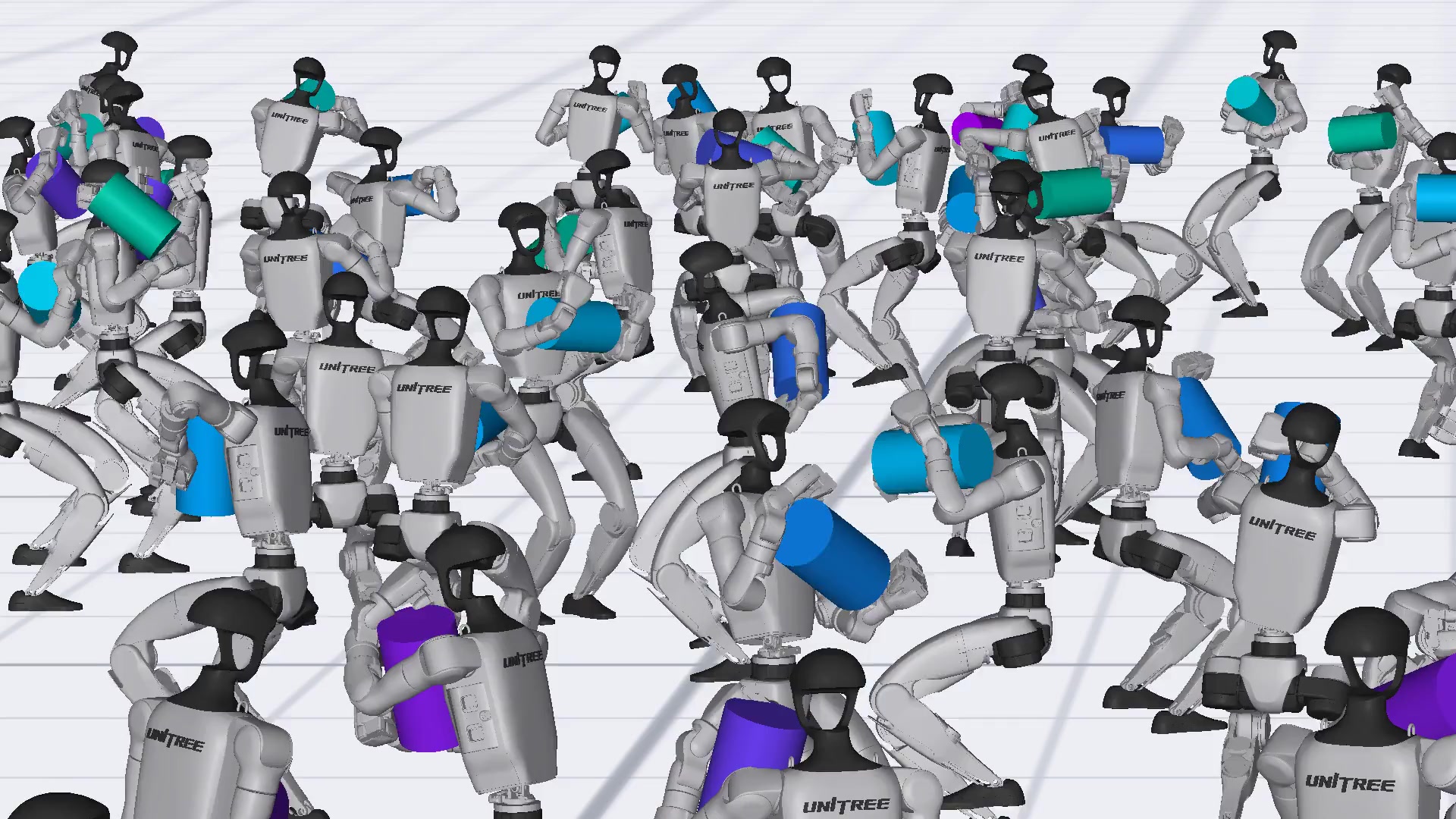
Initialize a grasp. Learn to carry.
Simulation: Push Disturbance Recovery
A side-by-side simulation comparison of disturbance recovery across FALCON, AMO, Thor, Ours, and Ours + DCM-CBF.
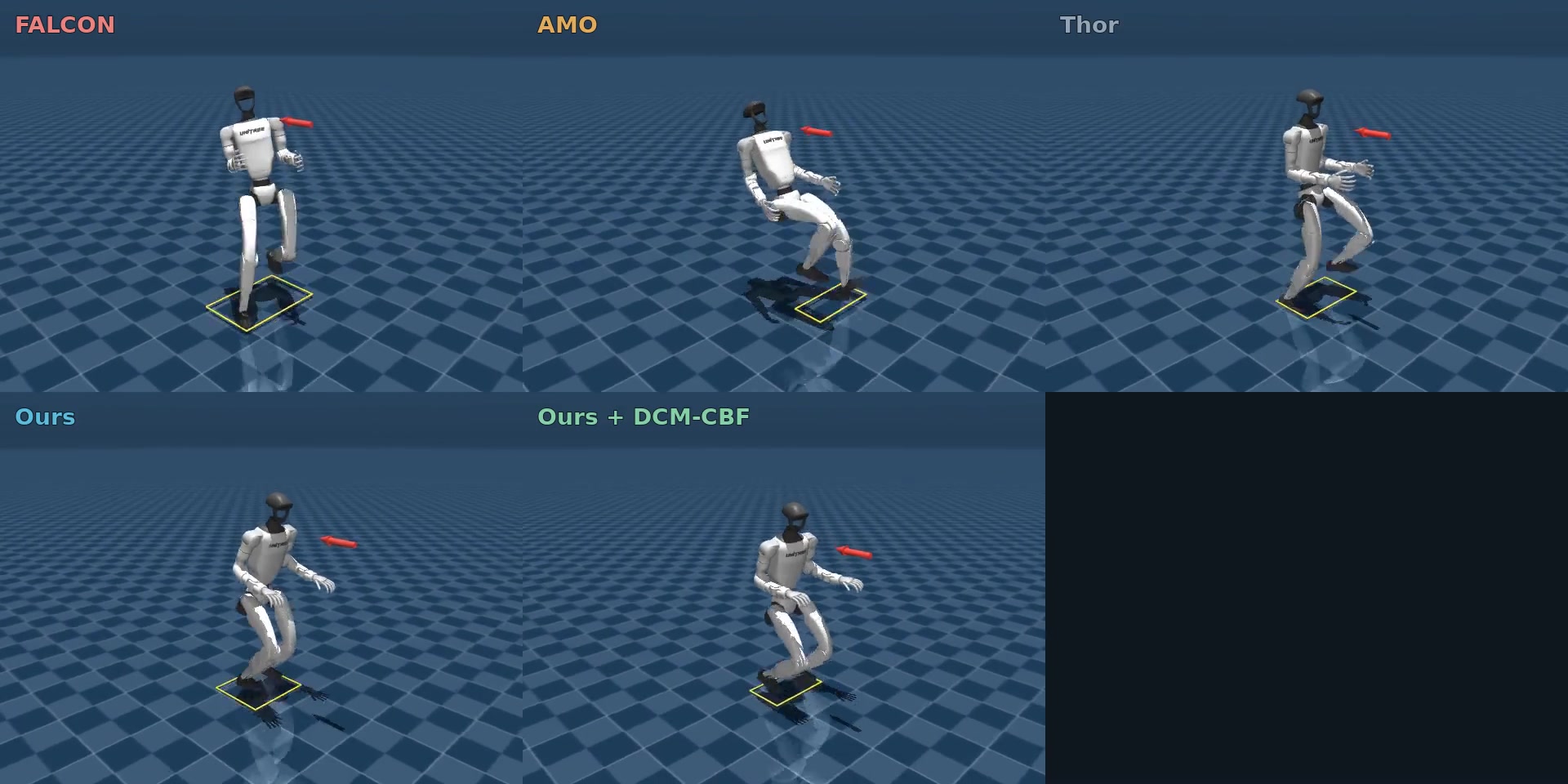
Push disturbance recovery
The presentation’s selected interval and original playback speed are retained; quantitative benchmark results appear in Table I below.
Real World Results
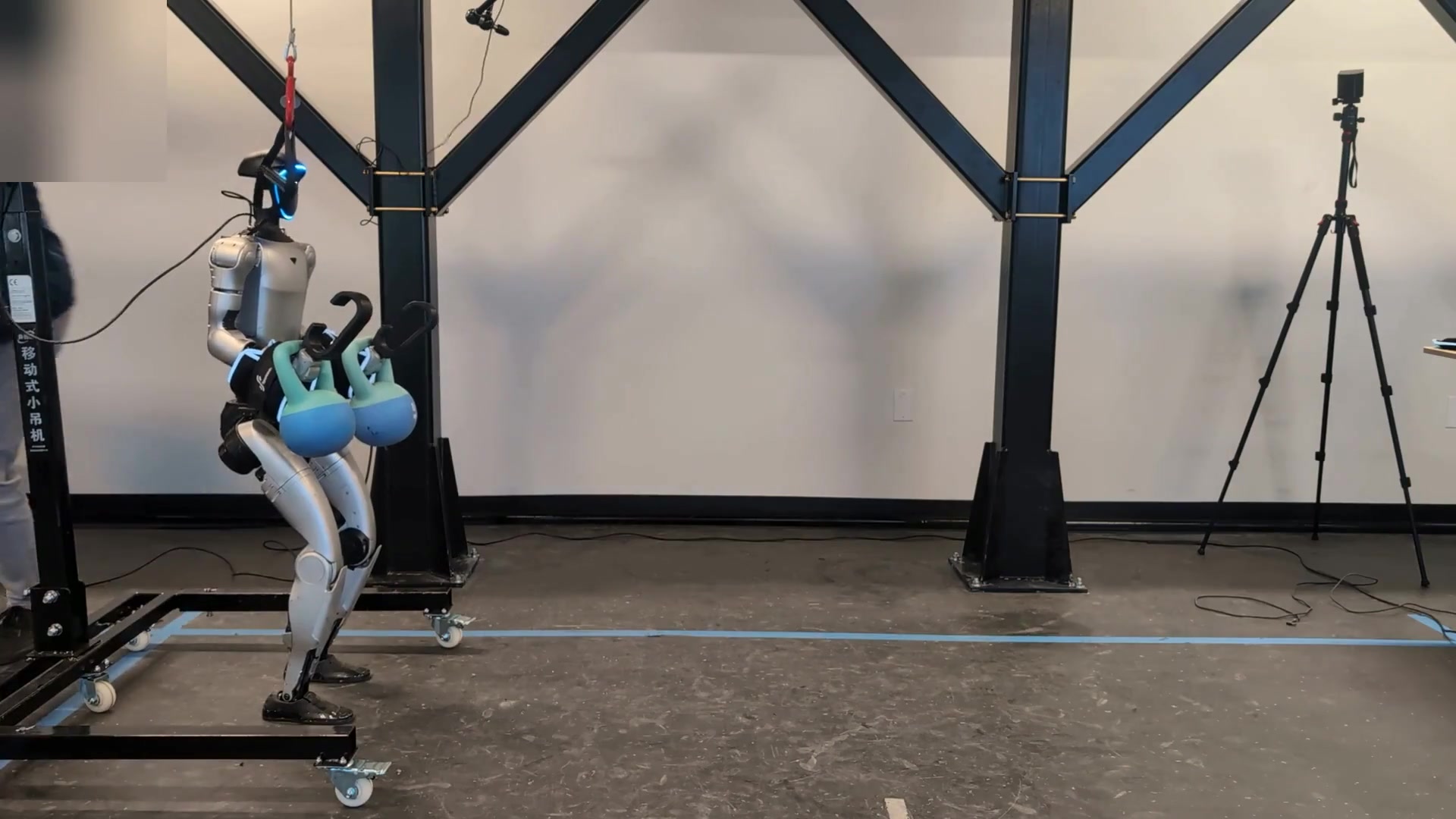
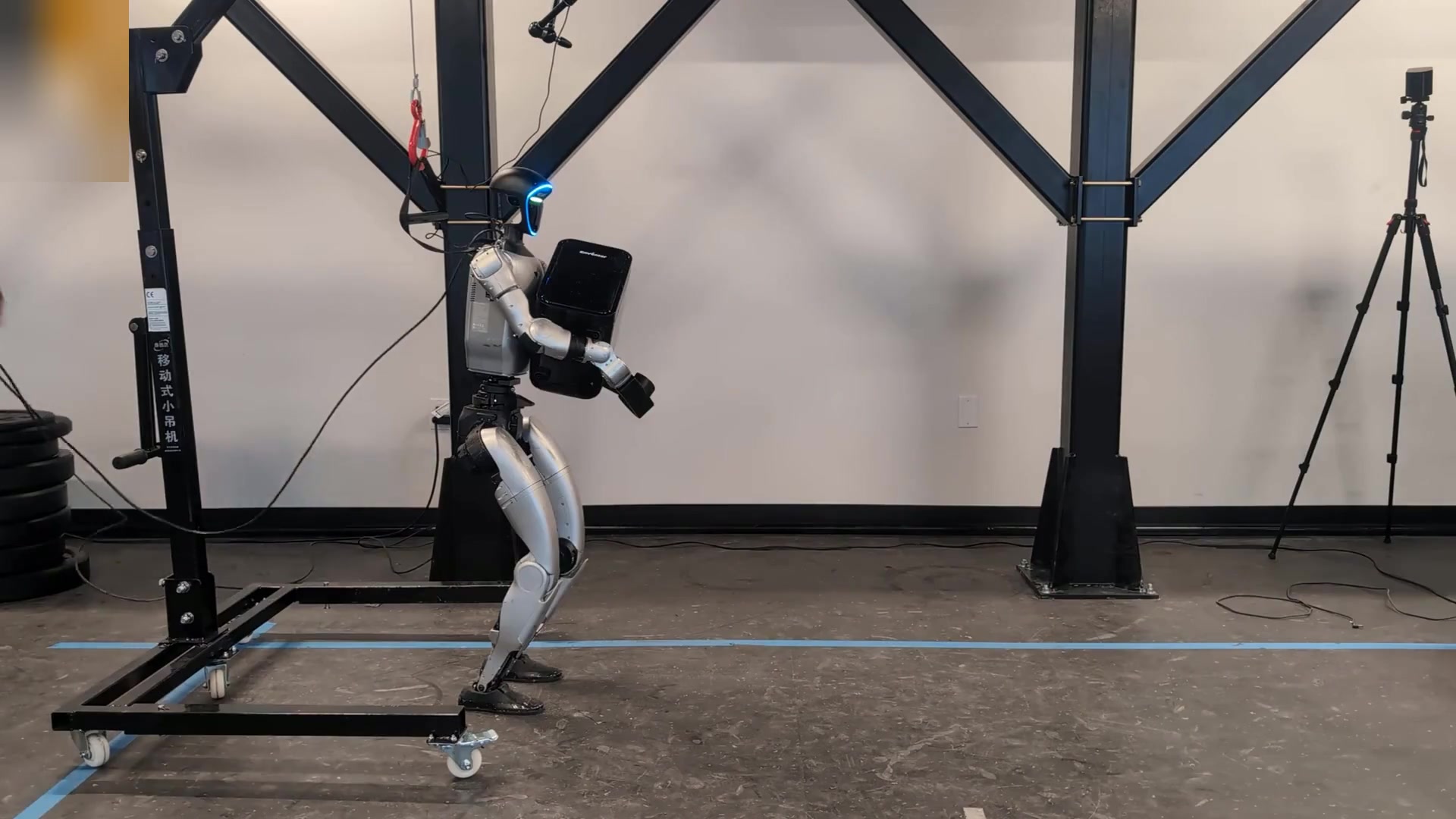
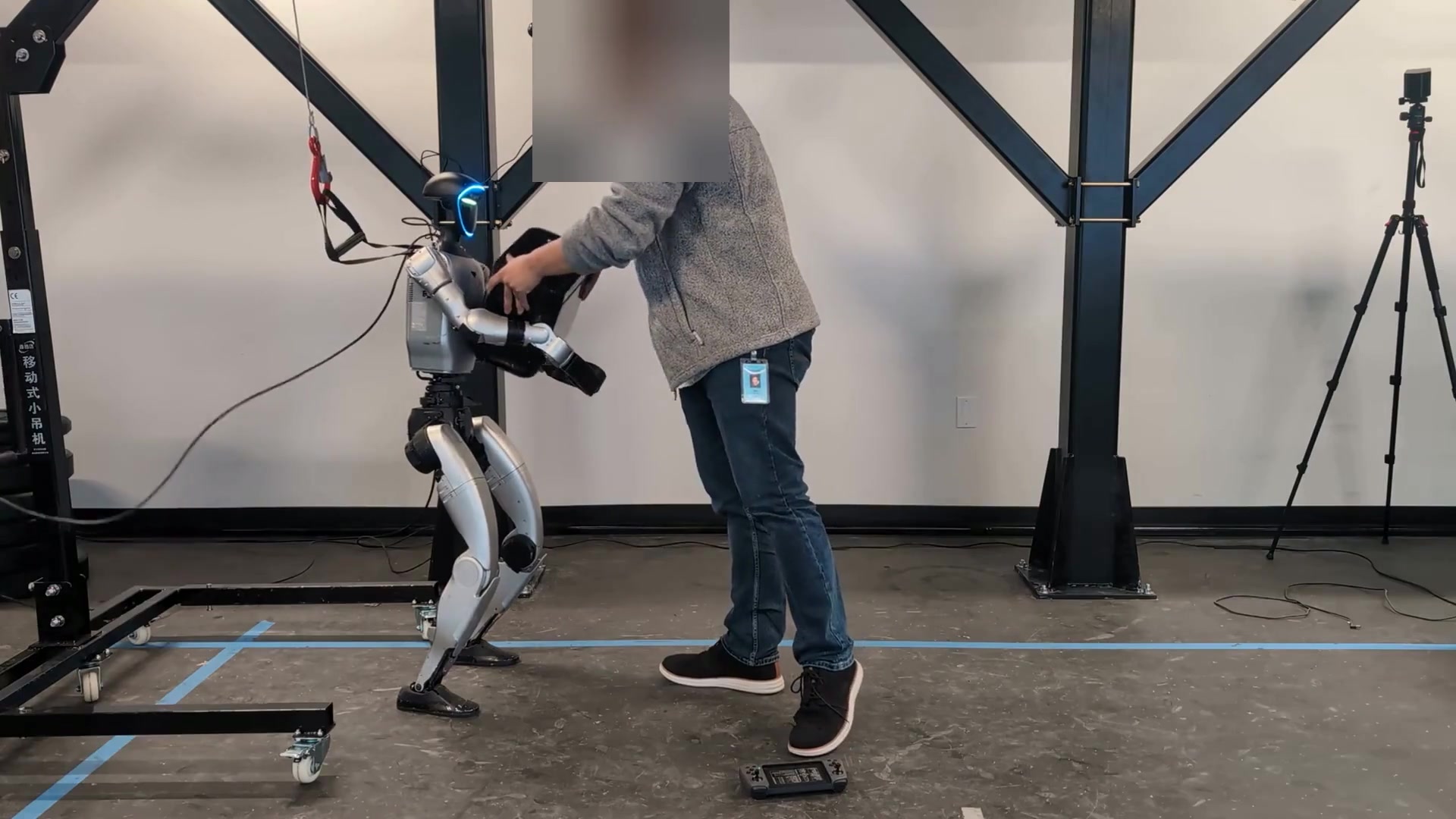
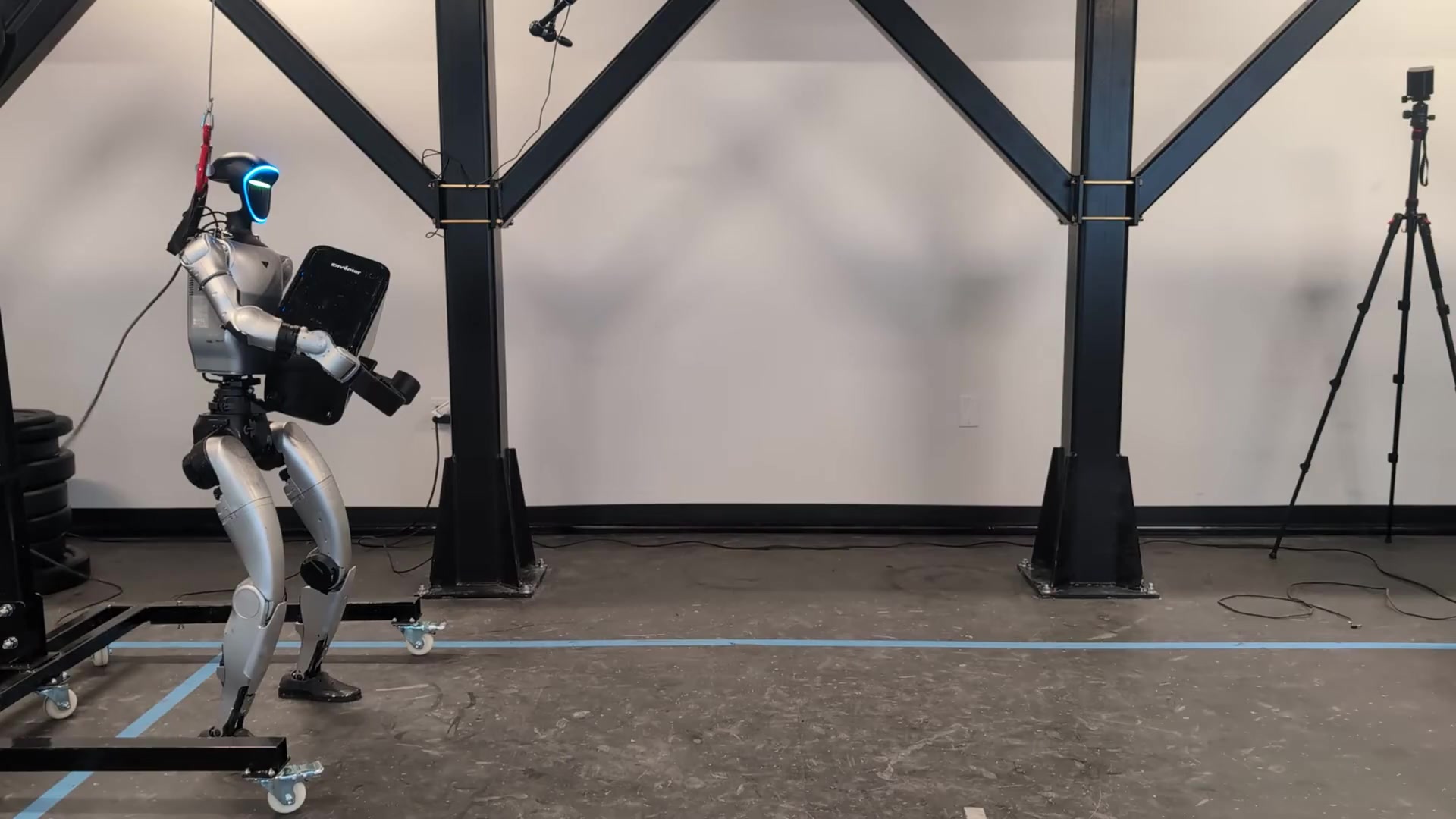
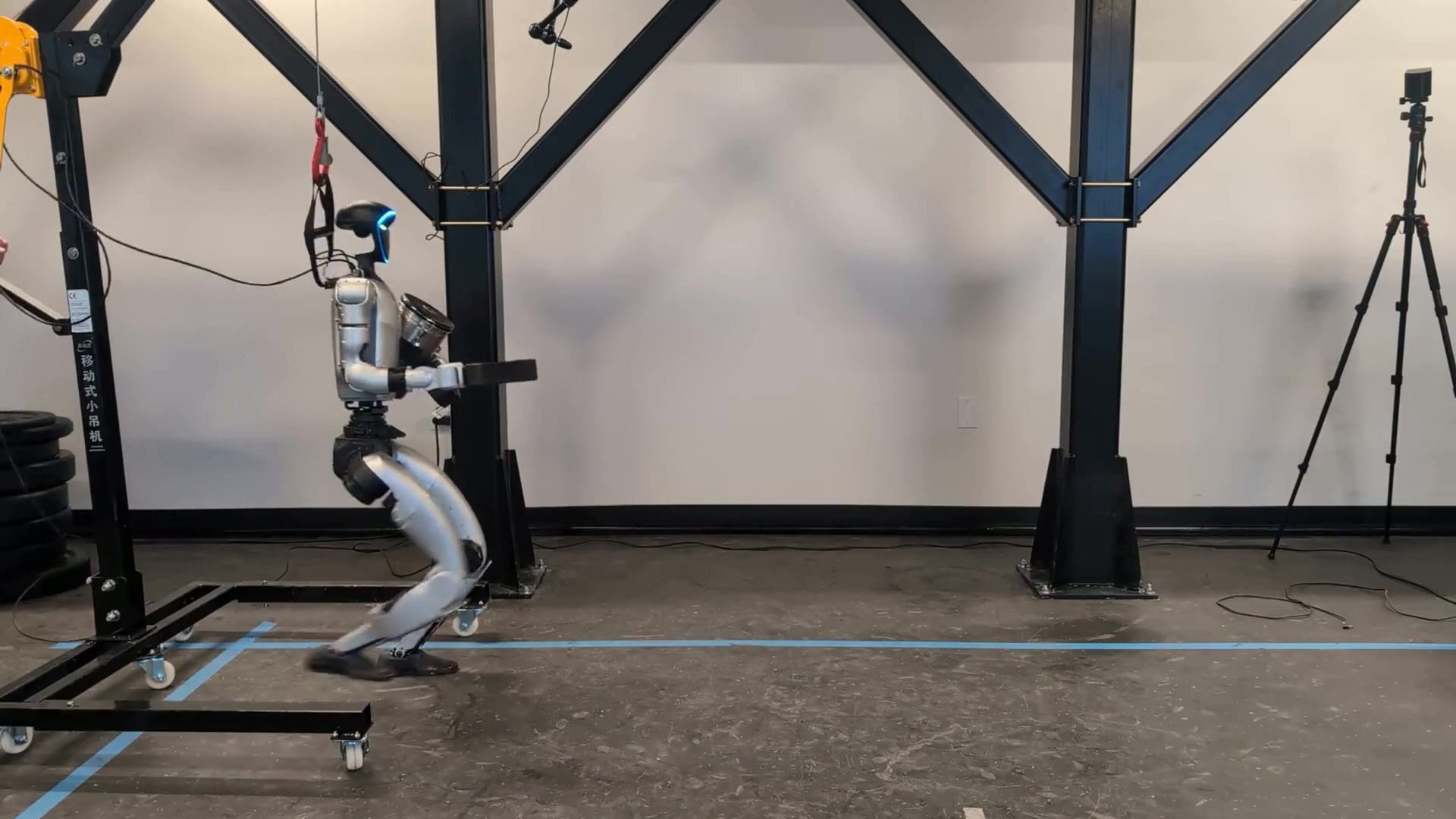
We benchmark against AMO, FALCON, and Thor on four real-world tasks: cart pulling, payload carrying, fridge carrying, and canister carrying.
Hardware highlight
300 kg cart pull
HULK pulls a 300 kg cart in the standalone hardware demonstration.
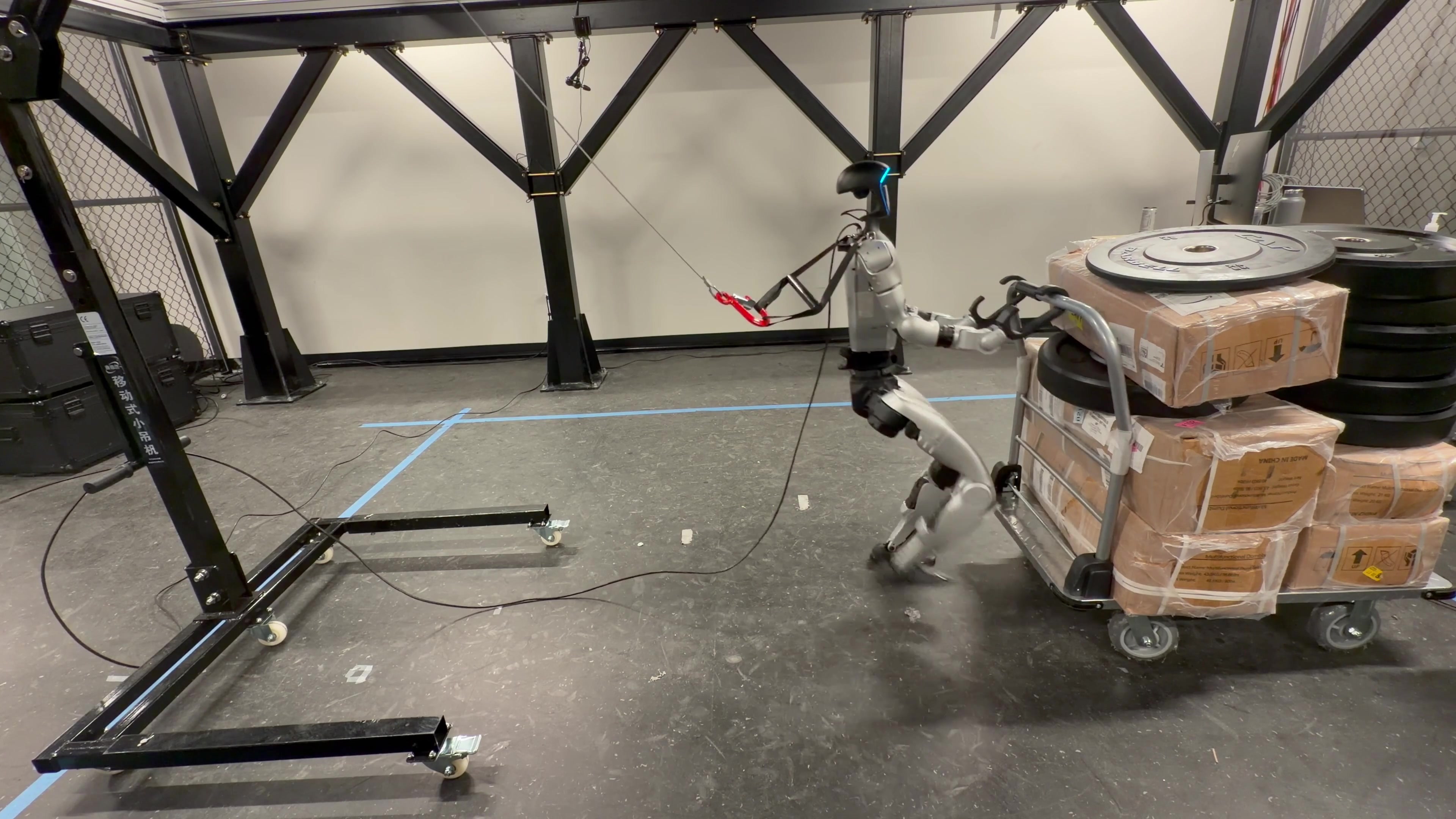
300 kg cart pull
The 300 kg value describes cart load, not pulling force; aggregate results are reported separately below.
Cart Pulling
HULK (Ours)
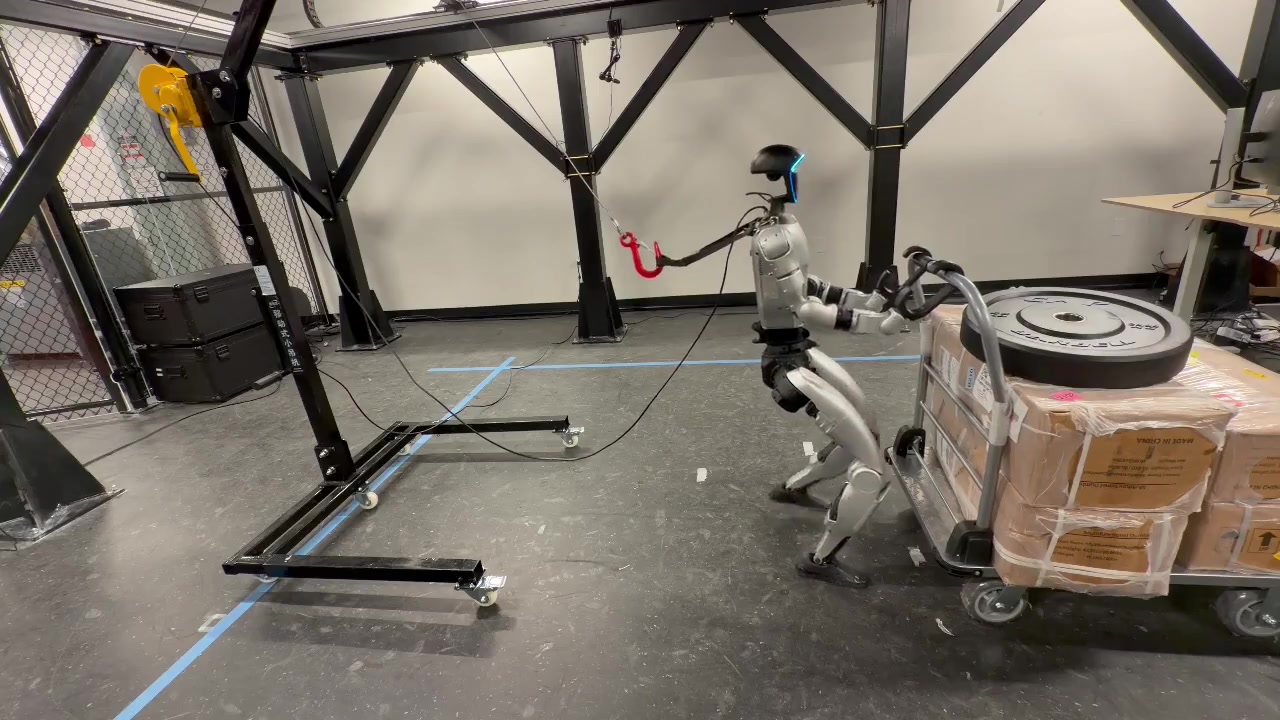
Cart Pulling
FALCON
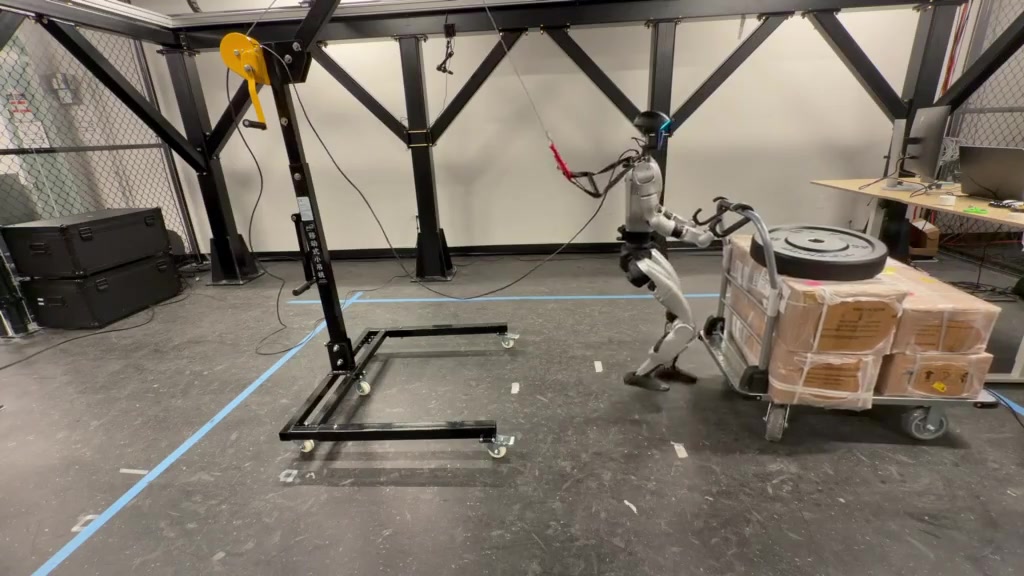
Cart Pulling
Thor
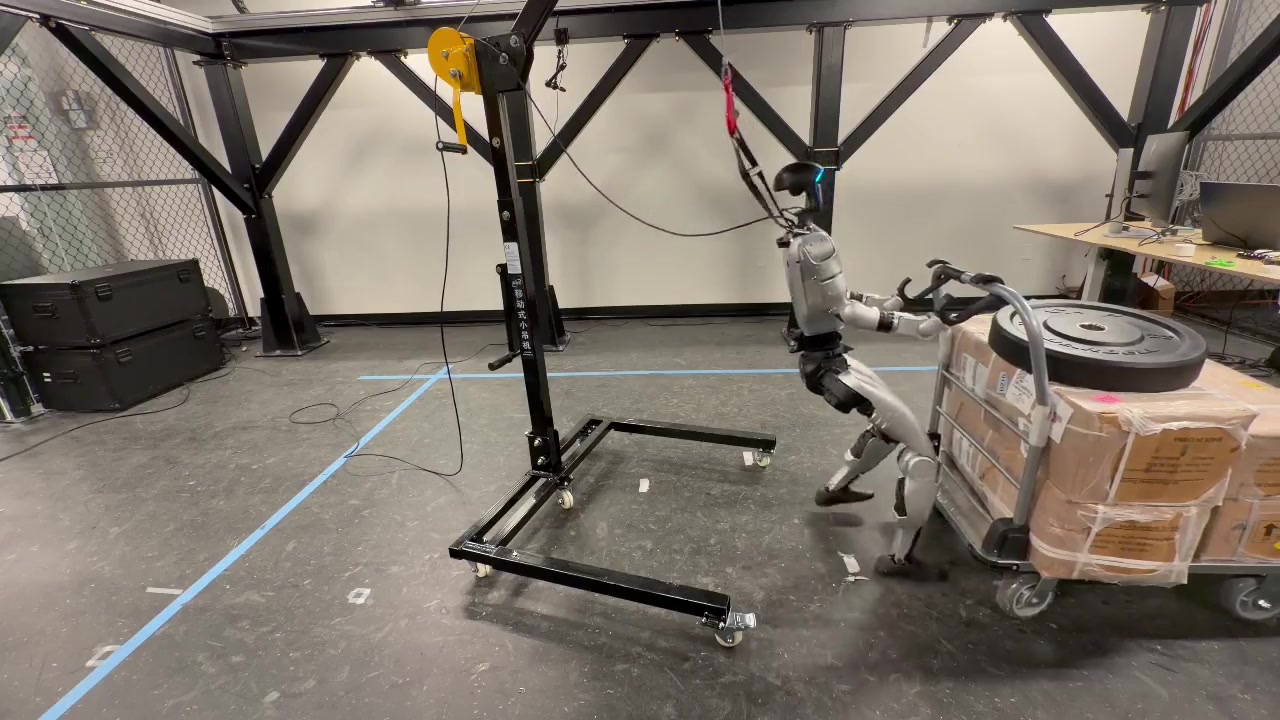
Cart Pulling
AMO
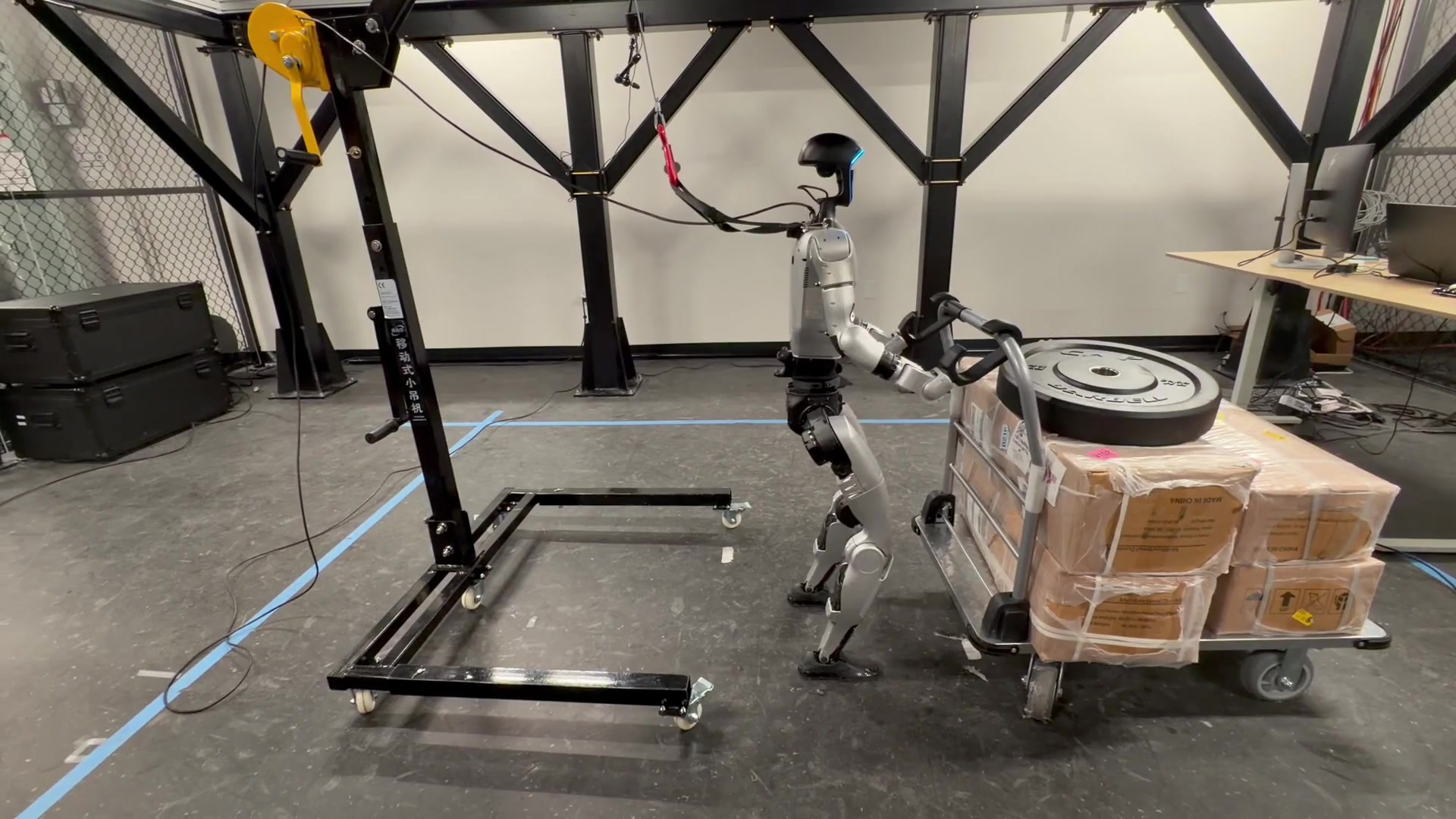
Cart Pulling
Payload Carrying
HULK (Ours)
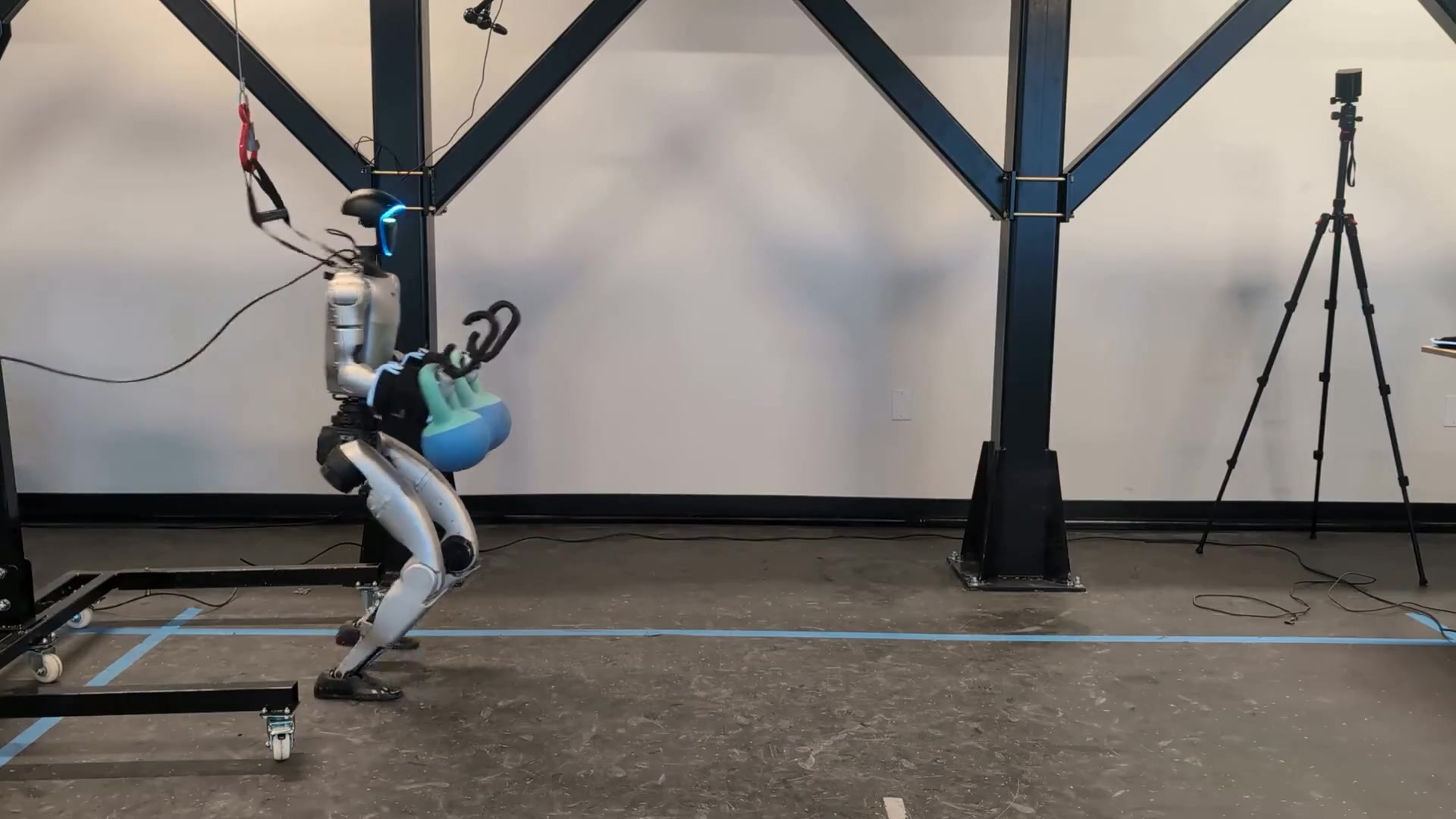
Payload Carrying
FALCON
Payload Carrying
Thor
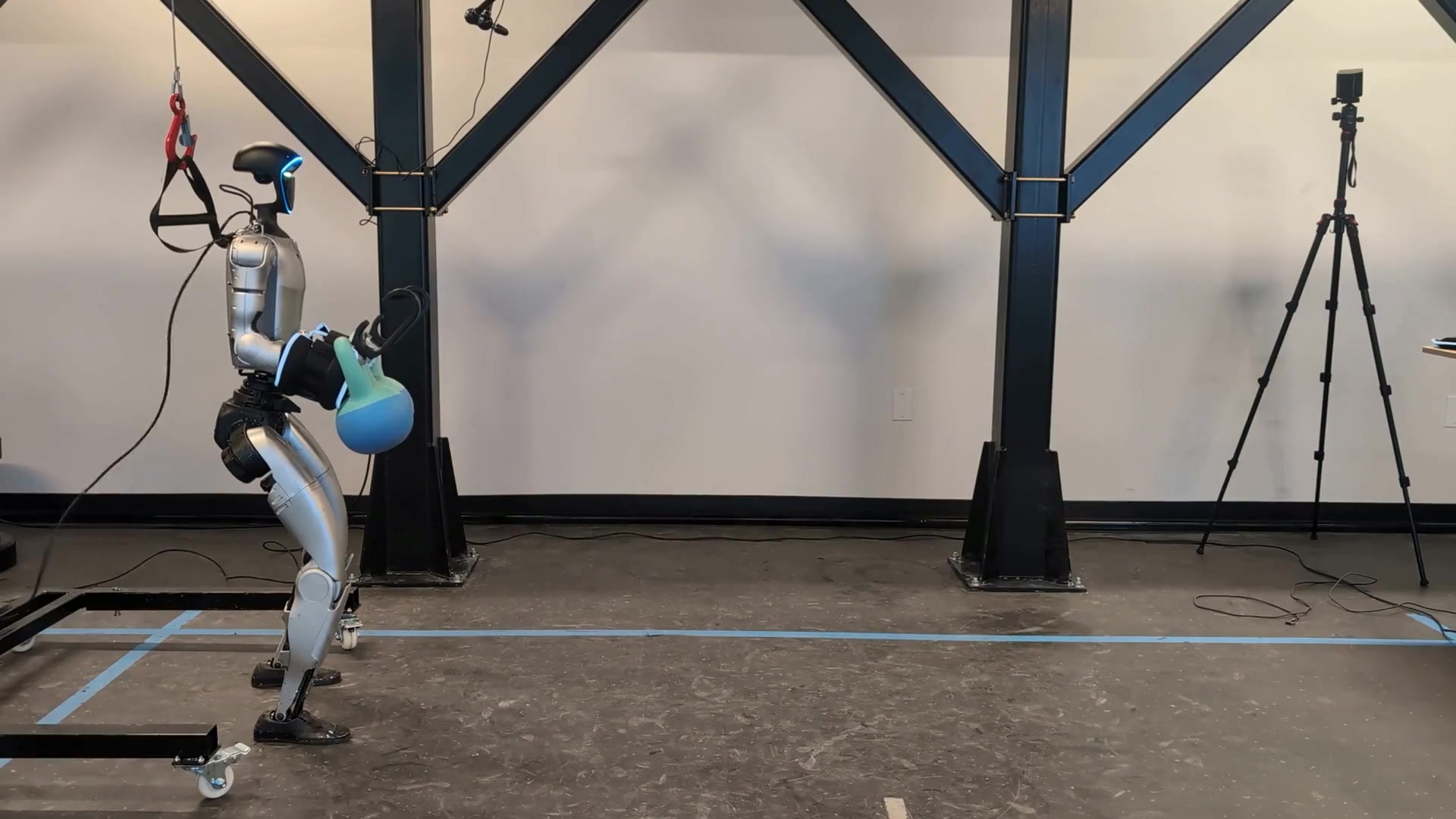
Payload Carrying
AMO
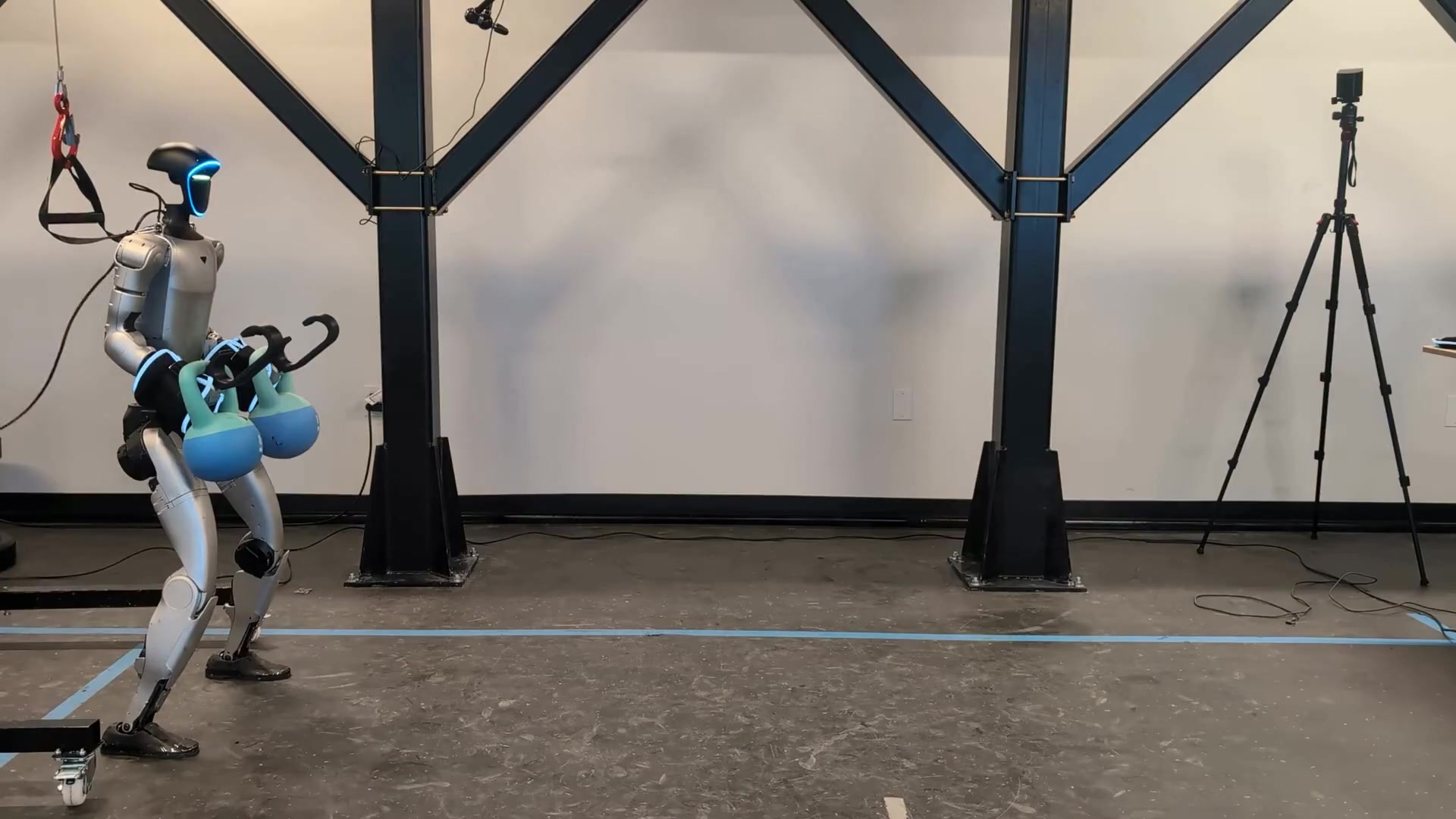
Payload Carrying
Fridge Carrying
HULK (Ours)
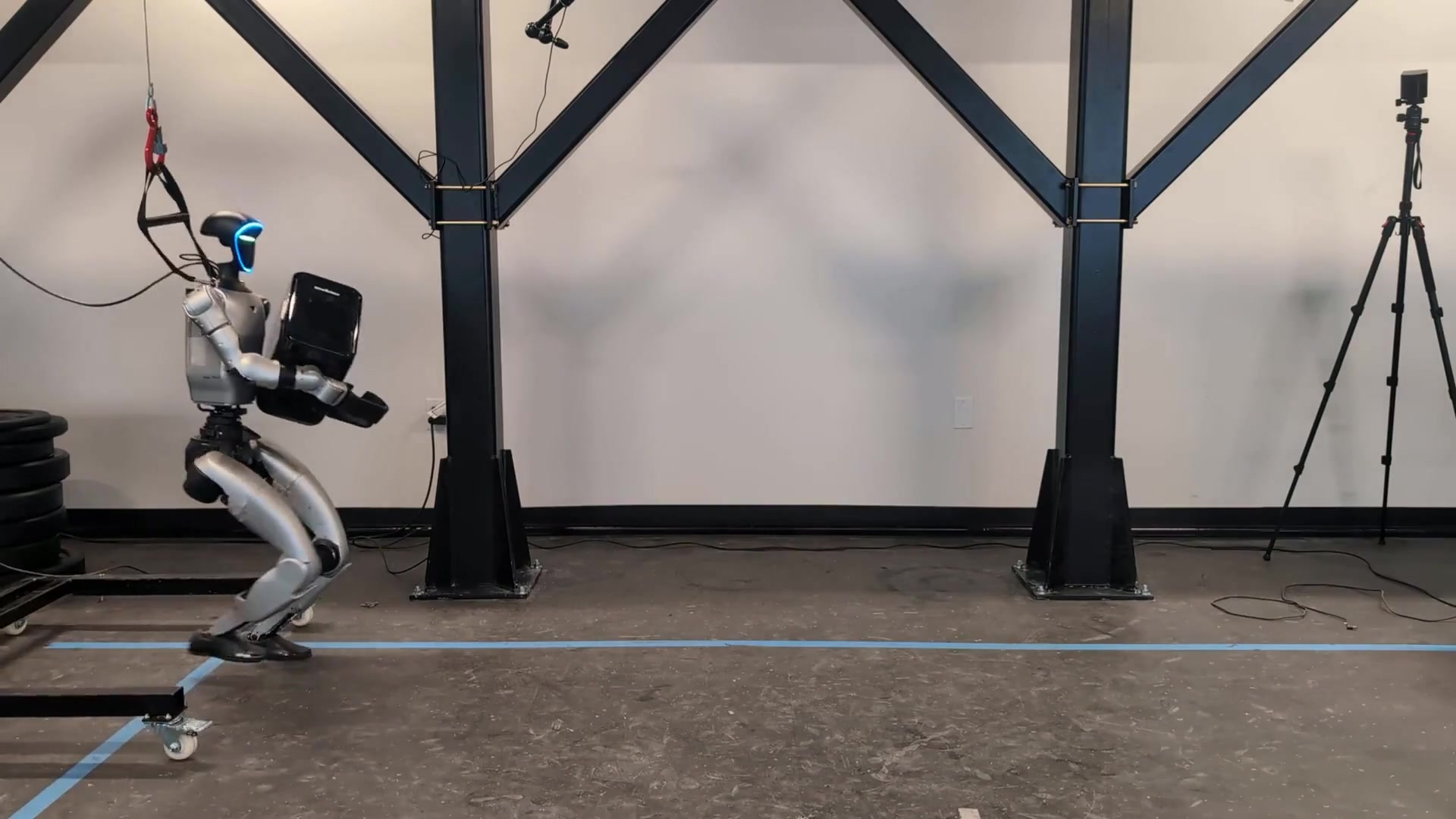
Fridge Carrying
FALCON
Fridge Carrying
Thor
Fridge Carrying
AMO
Fridge Carrying
Canister Carrying
HULK (Ours)
Canister Carrying
FALCON
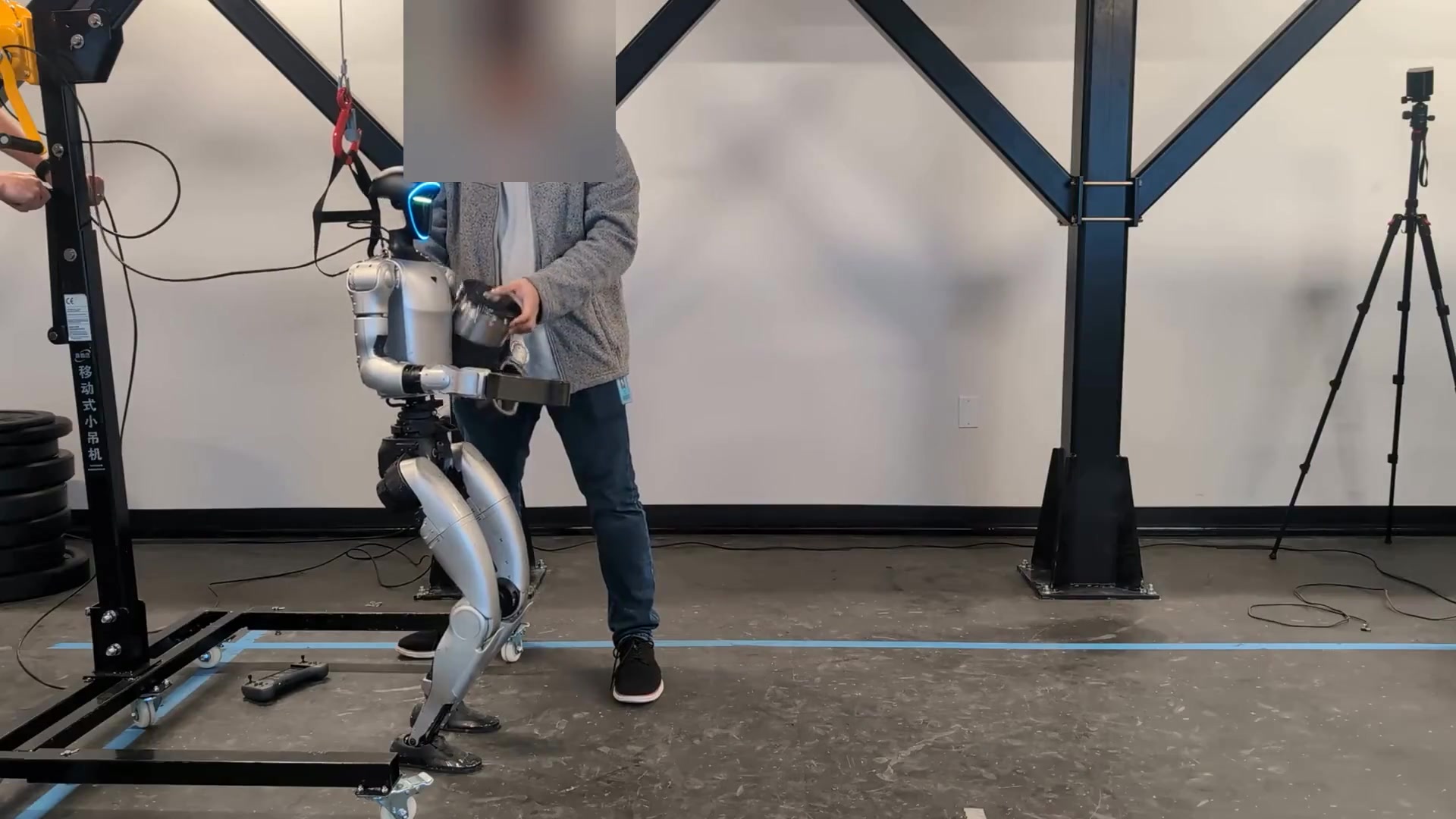
Canister Carrying
Thor
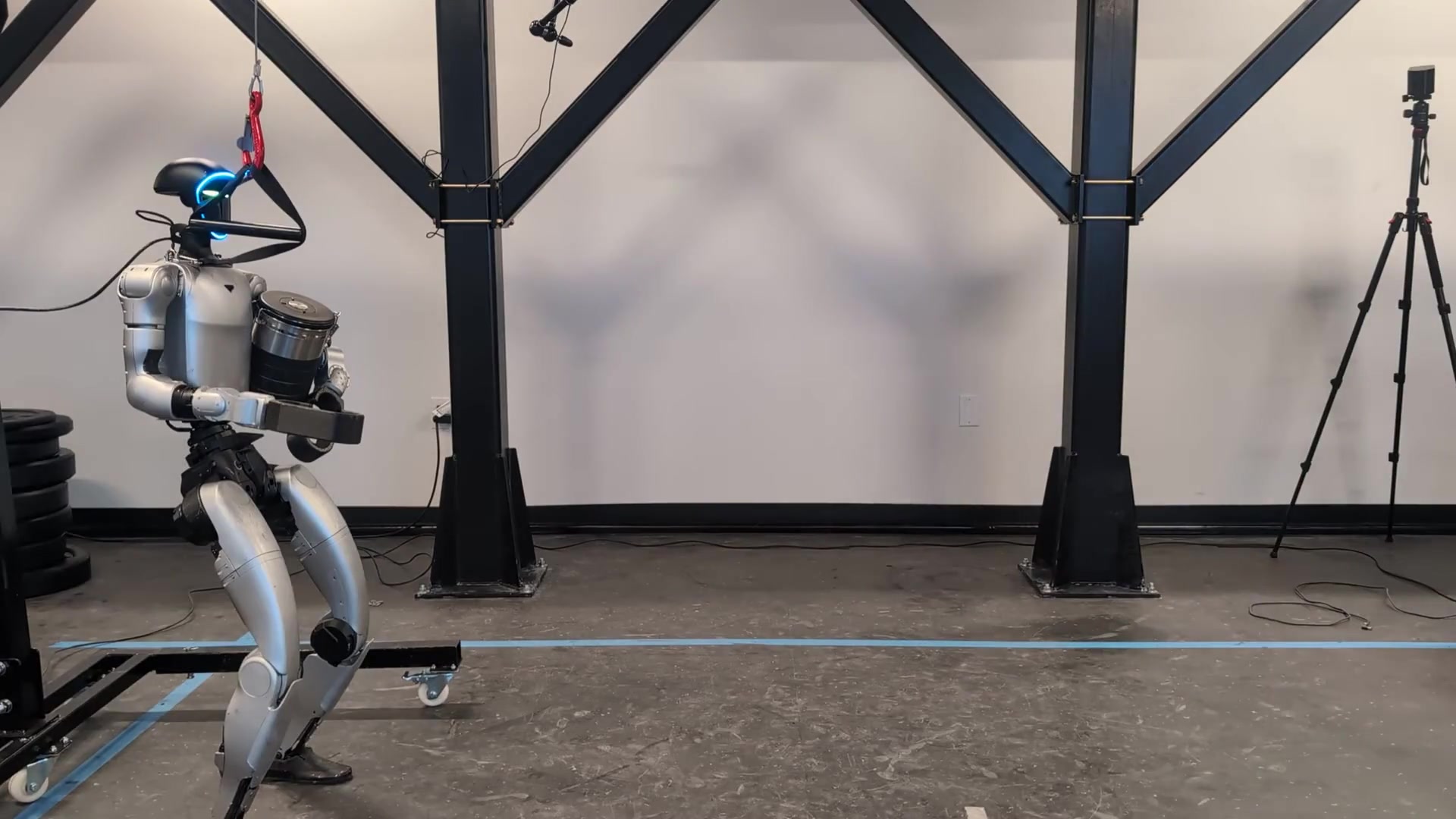
Canister Carrying
AMO
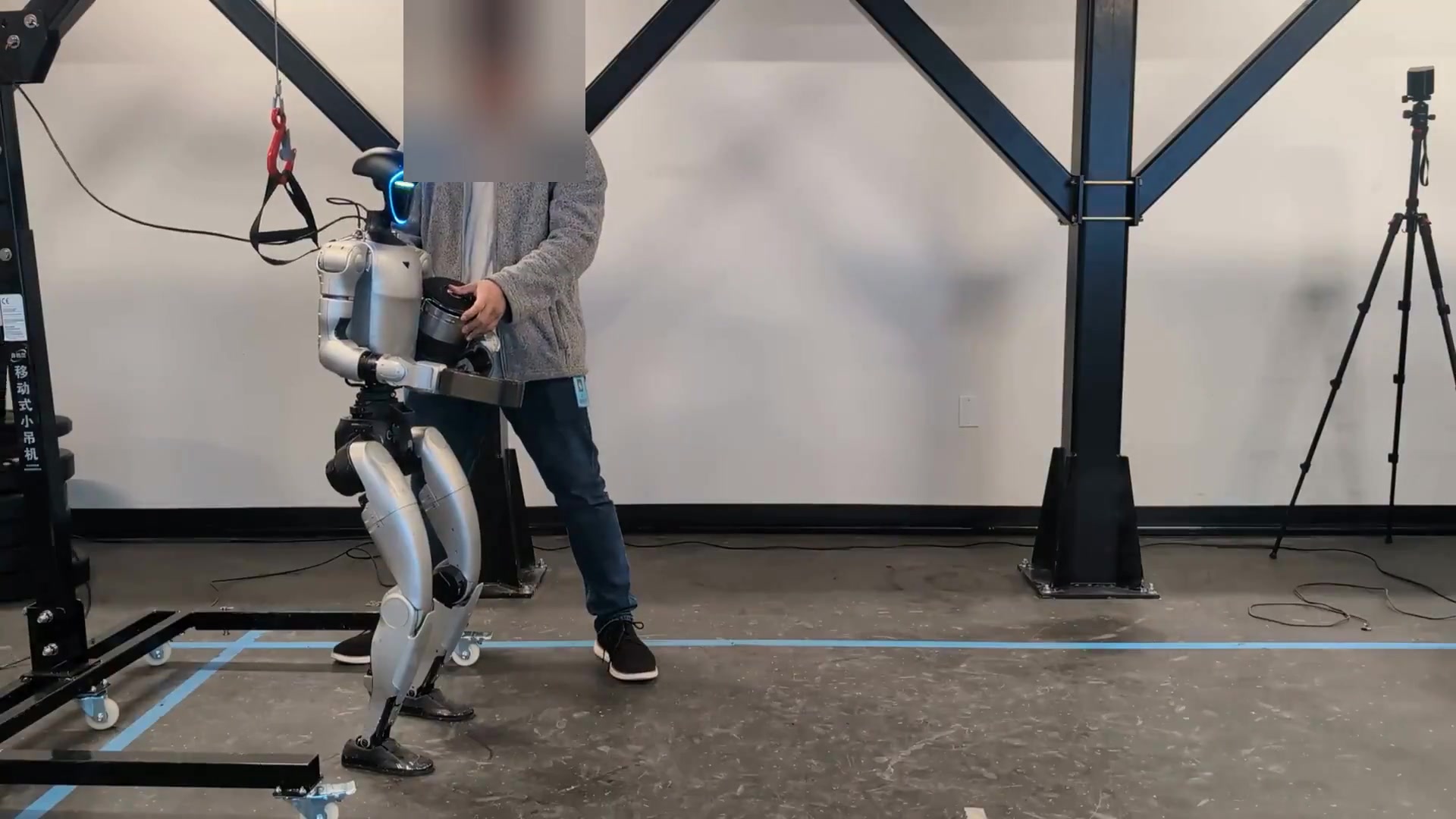
Canister Carrying
Benchmark Results
Carrying and disturbance rejection
This simulation benchmark measures walking-command tracking under 10 kg per arm and recovery from separate torso pushes, with mean ± standard deviation across five evaluation seeds. Our MPC-RL + DCM-CBF teacher has the lowest forward and lateral errors, smallest DCM excursions and peak tilt, and largest push survived, while AMO has the lowest mean turning error.
Swipe the table sideways to see all results.
| Method | Forward errorm/s ↓ | Lateral errorm/s ↓ | Turn-rate errorrad/s ↓ | Signed DCM marginm ↑ | Peak tilt · 50 Ndeg ↓ | Maximum pushN ↑ |
|---|---|---|---|---|---|---|
| Thor | 0.263 ± 0.002 | 0.265 ± 0.003 | 0.450 ± 0.006 | -0.275 ± 0.016 | 23.17 ± 0.13 | 80 |
| AMO | 0.276 ± 0.002 | 0.350 ± 0.004 | 0.196 ± 0.003 | -0.705 ± 0.030 | 9.94 ± 0.74 | 50 |
| FALCON | 0.367 ± 0.012 | 0.369 ± 0.013 | 0.392 ± 0.005 | -0.329 ± 0.034 | 7.91 ± 0.23 | 80 |
| Ours (MPC-RL) | 0.242 ± 0.009 | 0.257 ± 0.004 | 0.234 ± 0.008 | -0.251 ± 0.011 | 5.90 ± 0.18 | 110 |
| Ours + DCM-CBF | 0.210 ± 0.007 | 0.142 ± 0.003 | 0.197 ± 0.009 | -0.162 ± 0.012 | 5.59 ± 0.24 | 130 |
Real-world task performance
This Unitree G1 benchmark reports successful trials at a shared task load and the maximum load completed in all three trials of a separate sweep. Our distilled HULK student leads on cart pulling, fridge carrying, and canister carrying, and ties AMO on payload carrying.
Swipe the table sideways to see all results.
| Method | Cart push/pullTrials at 150 kg | Payload carryTrials at 11 kg | Fridge carryTrials at 6 kg | Canister carryTrials at 5 kg | ||||
|---|---|---|---|---|---|---|---|---|
| Completed ↑ | Max load · kg ↑ | Completed ↑ | Max load · kg ↑ | Completed ↑ | Max load · kg ↑ | Completed ↑ | Max load · kg ↑ | |
| Thor | 2/6 | 130 | 2/4 | 7.25 | 0/4 | 2 | 0/4 | 0.6 |
| AMO | 0/6 | 75 | 4/4 | 12.25 | 2/4 | 6 | 0/4 | 2.6 |
| FALCON | 3/6 | 200 | 0/4 | 3.62 | 0/4 | 2.5 | 0/4 | 0 |
| HULK | 5/6 | 300 | 4/4 | 12.25 | 4/4 | 7 | 4/4 | 6.1 |
BibTeX
@misc{hulk2027,
  title  = {HULK: Learning Whole-Body Forceful
            Loco-Manipulation for Humanoids},
  author = {Anonymous Authors},
  year   = {2027},
  note   = {Anonymous manuscript}
}
Draft citation. Publication details and authors will be updated.